 +38 (097) 642-77-27


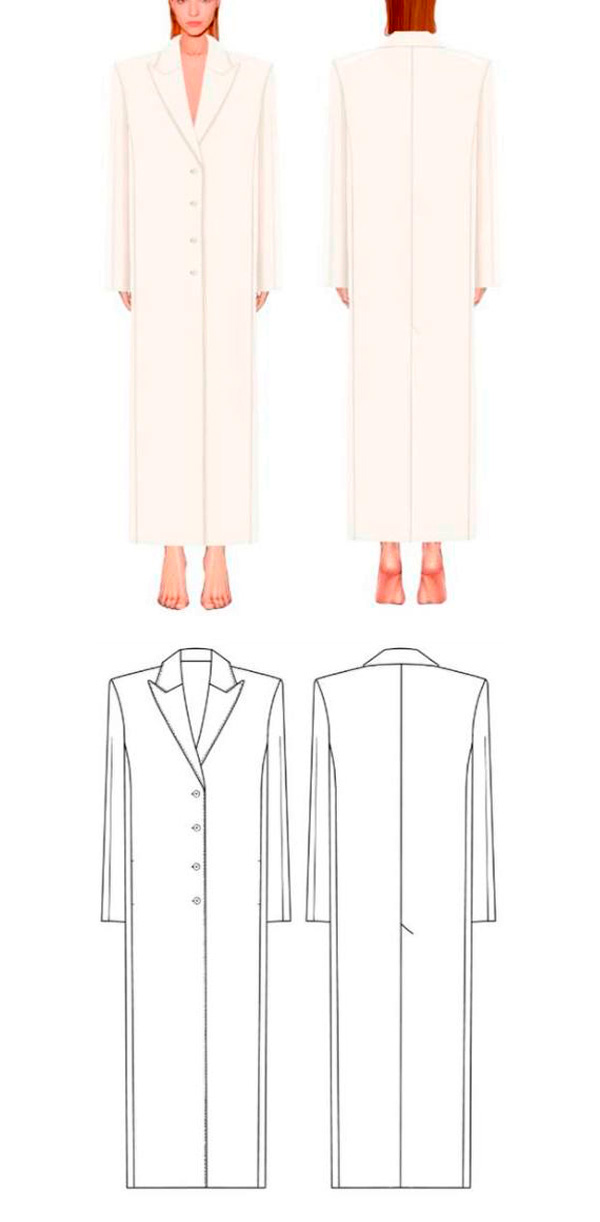 Technical information about the product
Source materials for development
One of the following must be provided:
• Product sketch (with design lines marked).
• Photos/references (front, back, side views preferred).
• Finished product reference (if you need to replicate or adapt it)
Product description
• Product type (coat, jacket, dress, trousers, etc.).
• Silhouette: fitted / oversized / straight / corset / anatomical.
• Length of the product and sleeve length.
• Type of collar, fastening, cuffs, yokes.
• Number and type of pockets. • Design features (neckline, drapery, slits, undercuts, reliefs, folds). • Decorative elements (fittings, stitching, edging, trim).
Fabric and materials
• Main fabric (name, composition, density).
• Lining.
• Interfacing (interlining, dublerin — density).
• Accessories (buttons, zippers, snaps).
Important: if the customer has not specified the fabric, the sample may fit differently after switching to a different fabric.
Size of the initial design
Please specify:
• The size for which we are designing the patterns (e.g. 36, 5, 48 IIA, etc.).
• If the sample is made according to parameters, provide accurate measurements taken according to the diagram
• Specific features of the figure (slouching, raised shoulder, asymmetry).
Recommendation:
To ensure that the sample fits correctly and is suitable for mass production, it is recommended to sew it on an anatomical mannequin of a standard size. This ensures the accuracy of the design, stability of the shape and correct fit on most figures.
Technical requirements
• Fit parameters (looseness of fit across the chest, waist, and hips). • Type of edge and seam finishing. • Requirements for internal finishing (labels, edging, lining, adhesive details). • Desired appearance inside (factory, premium, economy).
Number of fittings
• 1 fitting — basic design.
• 2 fittings — taking into account changes in fit.
• 3 fittings — final adjustments (if necessary).
The more complex the product, the more fittings may be required.
We typically conduct 1-3 fittings to refine the fit and design.
During the first fitting, we record basic changes: fit, length.
During the second fitting, we check the corrections made and approve the final sample.
All changes that go beyond the initial technical specifications are paid for separately as additional design work.
Corrections after approval and delivery of the finished sample
Once the customer has approved the sample and picked it up from production, the model is considered agreed and completed.
In this status, the sample moves from the ‘production stage’ category to the finished product category.
• Any additional changes are not included in the cost of the initial development.
• All work is considered as new design corrections or product repairs, depending on the nature of the CHANGES.
• Any corrections are paid for separately, as production again involves a designer, cutter, seamstress and technologist to rework the already completed product.